
The Summit: Abide in Me
John 15:1-11
The View from the Summit
There are moments on a journey when the trail suddenly opens. You climb through switchbacks, push through thin air, and then, all at once, the view expands. The horizon stretches wide. The sky feels closer. Everything slows.
I’ve experienced that feeling while watching the Aurora Borealis (northern lights) during a trip to the Boundary Waters. I also felt it on top of Mount Langley, above the tree line, where the granite landscape looked almost like the moon. But in the Sierra Nevadas, the real summit wasn’t the highest point; it was the star-filled sky I saw the night before.
We set up our tents on a grassy meadow, and I found myself under a clear, moonless sky free from city lights. At 11.000 feet of elevation, I witnessed a night sky like nothing I had ever seen; thousands upon thousands of visible stars. I remember deciding to simply sleep under the stars that night, and I followed a satellite moving slowly across the sky, reflecting the sun like a single moving spark. No photo could have captured what I observed that night. It was more than just a view; it was an encounter.
A Summit moment.
No effort required. Not achievement accomplished. Just the presence of the Creator.
I’ve also felt that same presence far from the mountains. Once, it was in a church in Illinois on Mother’s Day 1991, when God moved through the whole congregation in a way I could almost see. Another time, it was during a quiet late-night drive across Michigan, with my wife and son asleep behind me.
Summit moments are not about altitude. They are about awareness.
I sometimes call these moments 'dancing with God.' They are times when His closeness feels “touchable”, impossible to miss.
But the truth is, summit moments are not the main goal of the Christian life. They come from something deeper.
They grow out of abiding.
The Vine and the Branches
Jesus’ words in John 15 are the center of the Summit:

“I am the true vine, and My Father is the vinedresser. Every branch in Me that does not bear fruit, He takes away; and every branch that bears fruit, He prunes it so that it may bear more fruit. You are already clean because of the word which I have spoken to you. Abide in Me, and I in you. As the branch cannot bear fruit of itself unless it abides in the vine, so neither can you unless you abide in Me. I am the vine, you are the branches; he who abides in Me and I in him, he bears much fruit, for apart from Me you can do nothing. If anyone does not abide in Me, he is thrown away as a branch and dries up; and they gather them, and cast them into the fire, and they are burned. If you abide in Me, and My words abide in you, ask whatever you wish, and it will be done for you. My Father is glorified by this, that you bear much fruit, and so prove to be My disciples. Just as the Father has loved Me, I have also loved you; abide in My love. If you keep My commandments, you will abide in My love; just as I have kept My Father’s commandments and abide in His love. These things I have spoken to you so that My joy may be in you, and that your joy may be made full.” John 15:1–11

Note the number of times the word abide appears in the eleven verses above. Ten times. Nine times as a command to the disciples, and once describing Jesus’ relationship with the Father.
The word translated “abide” is the Greek word menō, which carries the sense of:
remaining
staying
dwelling
continuing
making your home in Him
This is very different from the word John uses earlier in his Gospel.
“And the Word became flesh, and dwelt among us…” (John 1:14)
Here, “dwelt” translates the Greek word eskēnōsen - literally, “He pitched His tent,” the language of the tabernacle in the Exodus wilderness. It is temporary, mobile - God stepping into our world.
But in John 15, Jesus invites us into something far more permanent:
It is not just a tent, but a home. Not just a visit, but a union. It is not only God living with us, but us living in Him.
John uses two different Greek words to show a progression. In John 1:14, Jesus 'dwelt' (eskēnōsen) among us, meaning He pitched His tent, a temporary place to stay during his earthly ministry. But in John 15, Jesus calls us to 'abide' (menō), which means to remain and make our home in Him.
God comes near so we can stay near. Incarnation leads to union. Presence leads to abiding.
Where We Struggle: Drive‑By Abiding
Many of us attempt what I call “drive‑by abiding.”
We want a moment with God, not a life with God. We lean near Him without actually connecting to Him.
At best, this is just 'tabernacling.' It is not truly abiding.
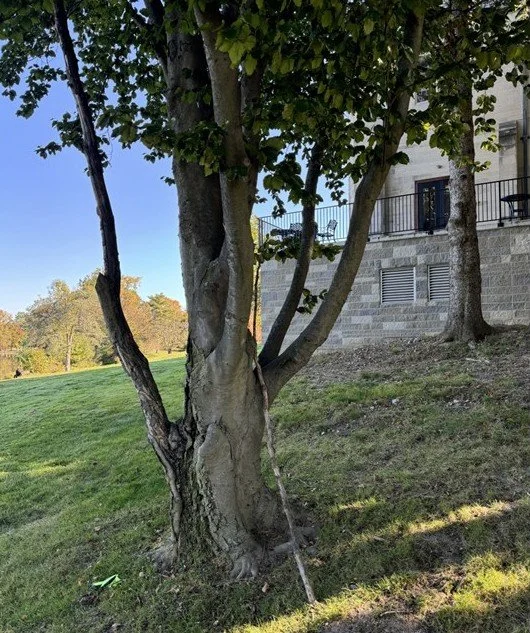
It’s like a fallen stick leaning against a tree.
It touches the tree. It rests on the tree. It may even look connected from a distance.
But it cannot bear fruit.
A branch can only bear fruit when it is connected, not just nearby.
Many of us want to hear His voice, grasp His guidance, and feel His presence.
But we want these things without the real connection that makes them possible.
Abiding is not leaning. Abiding is union.
The branch does not strain to produce fruit. It simply stays connected.
Fruit does not come from effort; it comes from being united with Him.
Jesus says:
“Apart from Me you can do nothing.” (v.5)
Not “less.” Nothing.
This is what the Summit means: it is not about climbing higher, but about staying closer.
Peter’s Summit: The Call Repeated
Peter’s story perfectly illustrates the Summit.
Matthew 4: The First Call
“Follow Me.” The beginning of apprenticeship. We spoke about this in “The Path”.
John 21: The Restoring Call
“Follow Me.” The beginning of abiding.
Same lake. Same shoreline. Same invitation.
Jesus meets Peter where his journey began, not to start over, but to help him grow deeper.
The first call was about movement, a call to follow Him. The second call was to fully experience His presence.
Peter’s life becomes the bridge between:
Follow Me
Abide in Me
You are in Christ
Abide in Me = Live as One Who Is in Christ
Jesus says: “Abide in Me.” (John 15)
Paul says: “In Christ.” (Many, many times … see 2 Cor. 5:17 for one example)
Different language. Same reality.
Jesus describes the experience: Union felt as relationship.
Paul describes the reality behind the experience: Union understood as identity.
Jesus: “Stay with Me.”
Paul: “You already are in Christ - now live from that reality.”
Jesus gives the metaphor and an invitation to relationship.
Paul gives the theology, an explanation of our spiritual position.
Position: You are in Christ. Assured and objective.
Posture: You abide in Christ. Daily and relationally.
Abiding is not a method; it is a way of staying connected.
But the practices you choose, like silence, reading Scripture, prayer, and stillness, help you move from being like a stick leaning against a tree to a branch that is truly connected.
Abiding is the experience of the union Paul describes.
This is the Summit.
Summit Moments vs. Abiding Presence
Summit moments are beautiful, like a Yosemite sunrise, Mother’s Day 1991, or a quiet Michigan highway, but they are not the whole story.
They are snapshots of what continual abiding makes possible. But abiding is not limited to these snapshots, these moments in time. Abiding is the ongoing development of a posture towards God.
Abiding is a posture that:
Remains connected to Jesus when we are trying to get our kids to multiple practices or birthday parties on the same night.
Reminds us of Scripture when a doctor's report isn't what we hoped for.
Creates a stillness in our response when the project at work becomes a late-night crisis.
Allows Jesus to prune a calendar or hobby that is keeping us from bearing fruit.
Provides the love we need to extend during a difficult discussion with a neighbor or family member.
Abiding reminds us that transformation happens slowly, and that summit moments are the overflow, not the goal.
They are gifts, not destinations.
They remind us that God is not far, but we are not always still enough to notice.
Living an Abiding Life
Abiding looks like:
A quiet morning opening God’s Word. Not to study, but to simply open your heart to His presence.
An evening walk through the woods, or your neighborhood, where you are not counting steps but becoming aware of His creation.
An honest time of prayer, not for control but surrender, and the Spirit gives unexpected clarity
A moment of worship focusing not on “performance” but communion and discovering that God feels closer than breath.
Your Summit Practice
Try a simple abiding prayer:
“Jesus, I remain in You.”
Choose one abiding activity this week:
10 minutes of silence
A slow walk with Jesus
A breath prayer throughout the day
A weekly “unhurried hour”
(A great one is Lectio Divina, but I will hold that exploration for a future post.)
Abiding is not about doing more. It is about being with Jesus.
A final note: abiding always leads outward.
Fruit is not for the branch - it is for the world.
Much like the other points on the Journey Compass, The Summit always leads somewhere. Once you begin abiding in Jesus, He invites you into a life of shared mission; to a life where His presence becomes your purpose, and His life becomes your life.
That’s the next movement in the Journey Compass: The Outbound Trail: Therefore Go.
In His Fields, Jon